The story of the National Western Center Campus (NWC) is one of transformation. What began as open stockyards and railroad lines has evolved into a global destination for agriculture, education and entertainment. Long before the modern campus took shape, this site along the South Platte River served as the beating heart of Denver’s livestock and agricultural heritage.
Today, the National Western Center continues to grow and redefine what it means to be a hub for ideas and impact. As a year-round destination for events and a center for advancing food, water, and energy solutions, the campus embraces the future while honoring its deep roots and communities. The echoes of its past live on through preserved historic buildings and the powerful stories they continue to tell.
A Site Born of Opportunity
The land that now houses the National Western Center was once a crossroads of opportunity. Located just north of downtown Denver, it was prized by early settlers for its proximity to the railroad, the lifeline of western commerce. By the late 1800s, rail lines crossed the area, making it the perfect place to handle one of Colorado’s most valuable commodities: livestock.
In 1881, the Denver Union Stock Yard Company was founded on the site. With three major rail lines converging here, it quickly became a vital hub for cattle, sheep, and swine trading across the region. What began as a handful of stock pens soon grew into a sprawling complex of corrals, warehouses, and rail spurs. By the turn of the century, this site had positioned Denver as one of the largest livestock-trading centers in the nation.
The annual National Western Stock Show, founded in 1906, would soon cement the area’s reputation as a gathering place for ranchers, farmers, and visitors from across the West.
Architecture That Tells a Story
Walking through the National Western Center today, visitors can still spot many of the architectural remnants that reflect the era of industry and growth. A historic preservation study was completed in 2014, identifying thehistoric buildings on campus. Each building and structure tells a story about the people, commerce, and culture that shaped Denver’s rise as an agricultural powerhouse.
The Exchange Building
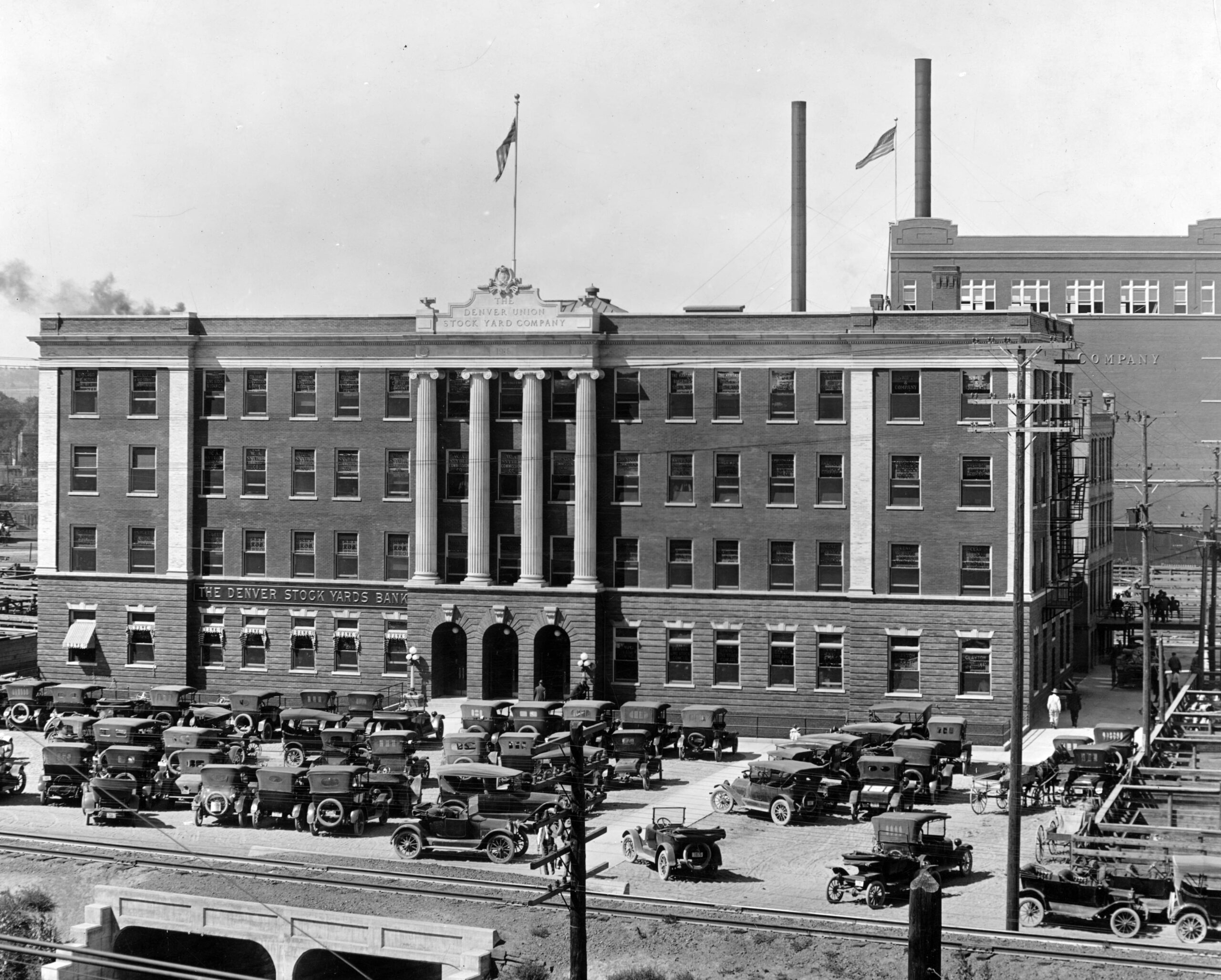
One of the most recognizable is the Exchange Building, originally constructed in 1898 and expanded in 1916 and 1919. This Beaux-Arts style landmark served as the headquarters for the Denver Union Stock Yard Company. Inside, its offices once buzzed with brokers trading cattle and sheep, while the building’s upper floors hosted everything from a bank and restaurant to the offices of the Colorado Farm Bureau and the U.S. Bureau of Agricultural Economics.
The Stadium Arena
In 1909, the campus expanded to include a permanent Stadium Arena (National Amphitheater and Livestock Pavilion), a neoclassical brick structure with seating for 6,000 spectators. This building helped usher in a new era for the Stock Show, becoming the primary venue from 1908 all the way through 1951, attracting national attention and firmly establishing Denver as a cornerstone of the livestock exhibition circuit.
Still in use today, this arena officially became a local historic landmark in 2016 to be preserved.
Armour & Company Office Building and Water Tower
Nearby the Exchange Building stands the Armour & Company Office Building, built in 1917 alongside its distinctive water tower, both rare survivors of Denver’s once-thriving meatpacking district. The Armour Building is the only remaining building of the Armour & Company meat packing plant which at the time was the largest Colorado Packing and Provisions Company. Although not back in use yet, in 2019, Denver officially designated the building as a local historic landmark, preserving its unique history for future generations.
The Armour Water Tower still stands today on campus. Armour & Company built a water tower around 1920 to provide water to the meatpacking plant. Over one hundred years later in 2020, the tower was rehabilitated and moved to the heart of the NWC campus. Standing 150-tall adjacent to the Livestock Center and the Stockyards Event Center, it now serves as a historic landmark for the site.
Together the historic Armour Building and water tower recall the days when refrigerated rail cars and packing plants lined the riverbanks, processing thousands of animals daily for markets across the country.
The McConnell Building
Connected to the epicenter meatpacking district, the McConnell Building, a two-story warehouse, was built around 1930, becoming an auto garage until 1951 when the Swift meat packing plant started operating in the building until the 1960’s.
Now owned by CSU System, the building stands today restored and connected to the CSU Spur Hydro building and opened in 2022 to the public.
The Sheep Bridge
Spanning the South Platte River, the remains of the Sheep Bridge tell yet another story of the site’s industrious past. Constructed between 1933 and 1936, this bridge once connected the Denver Union Stock Yards to meatpacking facilities on both sides of the river. The bridge was used to move sheep and linked directly to what was once the largest sheep barn in the world.
Though it no longer reaches the west bank, the preserved section of the Sheep Bridge stands today as an interpretive artifact, a silent yet powerful reminder of the region’s deep agricultural roots.
Neighborhood Roots and Cultural Heritage
The growth of the stockyards and meatpacking industry gave rise to nearby working-class neighborhoods, most notably Elyria-Swansea and Globeville. Established in the late 1800s and early 1900s, these communities were home to generations of immigrant families from Eastern Europe, Slavic, and Polish backgrounds who settled nearby to be within walking distance of jobs along the railway. Post-World War II population shifts brought more diversification, with Latino communities adding to the area’s rich cultural fabric.
As the meatpacking industry became more automated, these neighborhoods faced challenges, but they remained cultural centers filled with local businesses, churches, and social halls that reflected their residents’ pride and resilience. Their proximity to the site makes them integral to the story of the National Western Center. Today, these neighborhoods are deeply integrated into the NWC redevelopment, with the campus reflecting the goals and identity of Elyria-Swansea and Globeville. The story of these neighborhoods is woven throughout the NWC campus, seen through its artwork, architecture, and the voices of the surrounding community.
The NWC continues to honor this shared history by collaborating with community partners and cultural organizations to preserve and celebrate these neighborhoods’ legacies.
The Shifts, Decline, and Renewal
As the 20th century progressed, livestock trading began to change. Advances in transportation and the rise of feedlot operations led many companies to relocate outside of urban centers. By the 1970s, the stockyards’ daily activity had slowed dramatically, and much of the industrial landscape fell quiet.
Still, one tradition never faded: the National Western Stock Show. Each January, Denver continued to host the iconic event that had first put it on the agricultural map.
To support its continued growth, the Denver Coliseum was built in 1951, offering modern facilities for exhibitions and rodeos while the surrounding campus evolved to host larger crowds and a wider array of events. The site’s next great transformation came in 2015, when the National Western Center Master Planwas adopted. This ambitious plan envisioned a year-round destination that would blend heritage with innovation, a place where historic preservation, sustainability, education, community engagement, and events come together.
A Living Legacy
Today, visitors to the National Western Center can experience this powerful intersection of old and new. The historic Exchange Building stands proudly beside modern spaces like the CSU Spur campus, symbolizing a bridge between Colorado’s agricultural roots and its forward-looking spirit of discovery.
Whether you’re attending the Stock Show, exploring public art installations, or walking along the riverfront, the past is always present here, not as a relic, but as a living legacy that continues to shape the future of the West.
The National Western Center is more than a redevelopment project; it’s a story of resilience, reinvention, and respect for history. By honoring the people, buildings, and communities that made this site possible, the campus stands as a tribute to both heritage and hope.
We invite you to visit, explore, and experience how the National Western Center is preserving the past while building the future.
Stories from the center
Recent Stories